
Author: Dr. Ross Headifen (PhD)
Ross Headifen has a PhD in Mechanical Engineering and over 28 years of experience developing environmental and sustainable industry solutions. As co-founder of landfill biodegradable plastics brand Biogone and environmental equipment supplier FieldTech Solutions, Ross works closely with the food service sector—highlighting the importance of choosing plastics with a better end-of-life, particularly when most packaging ultimately ends up in landfill rather than being recycled. Biogone makes everyday plastic products with built-in landfill biodegradable technology.
Buy a bin liner that’s too small and it slides into the bin every time you drop something in. Buy one too big and you waste plastic, or it sags loosely and tears under the weight. Buy one that’s strong enough in theory but the wrong format in practice — flat top instead of tie handles, no leak resistance — and you find out the hard way over the kitchen floor.
Bin liner sizing isn’t complicated, but the product names don’t make it easy. A “small kitchen tidy” bag from one brand is a different size to another. “Garbage bags” covers everything from a 27L kitchen bin to a 240L council wheelie bin. This guide walks through how to match the bag to the bin — by size, by use, and by what you’re actually putting in it.
Quick reference: bin sizes and the liners that fit them
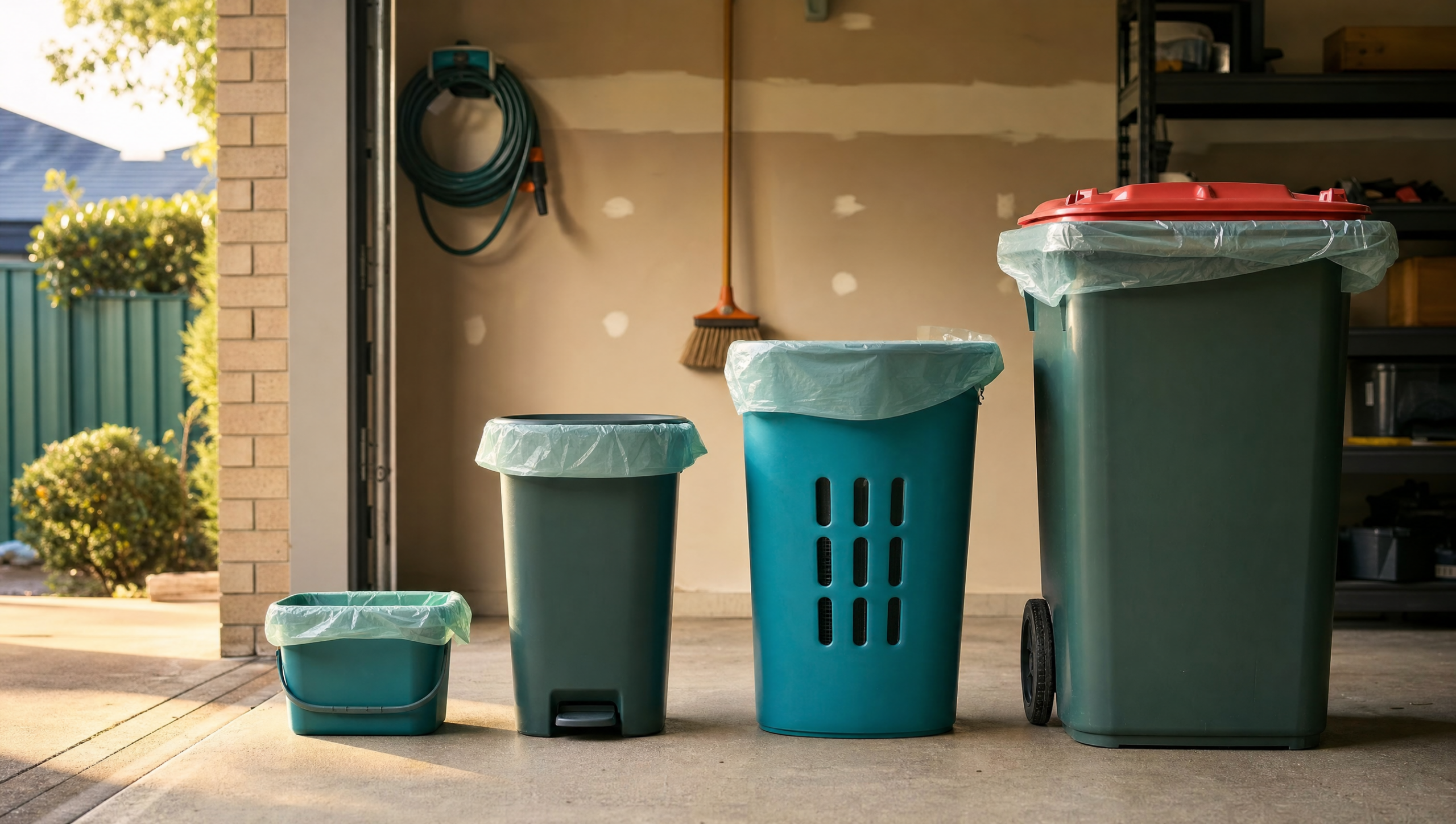
The fastest way to get this right is to know the litre capacity of your bin and match it to the liner. Most household bins fall into a small number of common sizes.
| Bin type | Typical capacity | Recommended liner | Common uses |
| Kitchen caddy / benchtop | 5–10L | 10L bin liner | Food scraps, FOGO collection |
| Small kitchen bin or sanitary | 15–27L | 27L bin liner | Bathroom, bedroom, study bins |
| Standard pedal-bin kitchen | 30–55L | 36L or 54L bin liner | Main household kitchen bin |
| Large kitchen, laundry, garage | 60–80L | 75L bin liner | Heavier waste, garage clean-outs |
| Council wheelie bin (red lid) | 120–240L | 120L or 240L bin liner | General waste collection |
| Outdoor / commercial wheelie | 240L | 240L bin liner | Council, business, multi-unit |
A rule of thumb: pick a liner with a stated capacity that matches your bin, and check the dimensions. A 27L bin liner is roughly 580mm wide and 700mm tall when laid flat — enough to drape generously over the rim of a 25L kitchen pedal bin without dropping in.
Small bins (10–27L): kitchen caddy and sanitary bins
Small bins do two distinct jobs and they call for different liners.
The kitchen caddy (food scraps)
A 6–10L benchtop caddy holds food scraps before they get transferred to a compost bin, a FOGO collection bin, or the general waste bin. Food scraps are wet, smelly, and prone to leaking. The liner needs to be leak-proof and strong enough to hold weight without tearing when you lift it out.
For caddies that get emptied into a compost bin or FOGO collection, choose a certified home compostable liner (AS 5810). These break down in backyard compost bins alongside the scraps themselves. Biogone’s 10L home compostable caddy liner is built for this purpose.
For caddies that get emptied into general waste, a landfill-biodegradable 10L liner is the better fit. Same leak resistance, same strength, but designed to break down in landfill rather than compost.
Bathroom, sanitary, and study bins (15–27L)
These bins usually take dry or low-volume waste and don’t need as much puncture resistance as a kitchen bin. A 27L liner with tie handles is the standard fit and gives you enough margin to gather and tie the bag cleanly when it’s full.
Medium bins (36–55L): the standard kitchen pedal bin
This is the workhorse category. The standard household kitchen bin in Australia is somewhere between 30L and 55L, which means a 36L or 54L liner is the right fit. The difference is mostly about how much margin you want at the top of the bin.
A 54L liner gives you generous overhang, which makes tying the bag at the end much easier — especially with wet waste that gathers weight in the bottom. A 36L liner sits flush and uses less plastic per bag, which suits smaller bins or households that empty more frequently.
Strength matters most in this category. A kitchen bin liner has to handle wet food residue, the occasional broken plate, and being dragged out of a bin under load. Look for a thickness of around 25 to 35 microns with a stated leak-proof rating. Anything thinner is built for dry waste only and will fail you in a kitchen setting.
Large bins (75–120L): the laundry, garage, and wheelie bin
Once you’re above 60L, you’re in territory where the bag is doing serious work. Garden clean-outs, garage decluttering, renovation debris, multi-day household waste before bin night — all of these put real strain on a liner.
A 75L liner is the practical sweet spot for most large-bin uses. It fits a standard 60–80L laundry or garage bin, and it’s manageable to lift when full. Biogone’s 75L is rated for the typical heavier-duty applications: kitchen waste, food scraps, garden waste, and general clean-up jobs.
Above 75L you’re generally lining a council wheelie bin or a commercial-scale waste bin. A 120L liner fits a smaller council bin or a large indoor commercial bin. A 240L fits the standard Australian council wheelie bin. At this size, the bag is mostly there to keep the bin clean and contain odours rather than to be lifted out — most people leave the liner in the bin when it’s tipped at kerbside.
Format features that matter
Size is the first decision. After that, a few format features make the difference between a liner you tolerate and one that just works.
- Tie handles vs flat top. Tie handles are easier to seal and carry cleanly. Flat top liners use less material but require you to gather and twist the top to tie, which is messier with wet waste. For kitchen and bathroom bins, tie handles are worth the small premium.
- Wave top vs straight cut. Wave-top liners (with shaped openings) give you more gather material and tie more cleanly. Especially useful for caddy bins where you’ll be handling the bag multiple times.
- Leak resistance. Critical for kitchen and caddy bins. The base seam is the failure point — a properly heat-sealed base liner doesn’t leak even with wet waste. Cheap thin liners often fail here.
- Thickness (microns). For kitchen bins, 25–35 micron is the practical range. Below 20 micron is dry-waste-only territory. Above 40 micron is overkill for household use and adds unnecessary plastic.
- Material thickness vs material strength. A well-formulated 30-micron liner can outperform a poorly-made 40-micron one. Look for tear-resistance and stretch ratings, not just thickness alone.
Landfill-biodegradable or home compostable? Choosing between the two
Both Biogone product lines look similar on the shelf, but they’re built for different end-of-life pathways. Picking the right one for your situation matters.
Choose landfill-biodegradable if:
- Your waste goes into the general waste bin and ends up in landfill (which is the case for most household general waste in Australia).
- You want a liner that performs identically to conventional plastic but breaks down in landfill conditions.
- You don’t have a backyard compost or FOGO collection that accepts compostable packaging.
- You want a long shelf life — landfill-biodegradable liners don’t start breaking down until they reach landfill conditions, so they keep indefinitely in your cupboard.
Choose home compostable (AS 5810) if:
- You compost food scraps at home and want a liner that breaks down in your compost bin alongside the scraps.
- Your council’s FOGO collection accepts certified home compostable bags (check with your council first — acceptance varies).
- You’re only lining caddy or small bins for food waste — home compostable liners are designed for this use case specifically.
Worth knowing: home compostable bags have a shelf life of 12–15 months from when it was manufactured, because the materials start to break down once exposed to ambient air and moisture. Buy what you’ll use and ensure that they’re stored in a cool, dry place. Landfill-biodegradable liners don’t have this constraint.
Common bin liner mistakes to avoid
- Buying one size for everything. A 50L liner in a 25L bin is wasteful and tears more easily where it overhangs. Match the liner size as closely as possible to the bin size.
- Using thin office liners for kitchen waste. Thin liners are designed for paper and dry rubbish. Wet kitchen waste needs at least 25 micron.
- Putting compostable bags in general waste and expecting them to compost. Certified compostable bags need composting conditions to break down properly. In landfill, they don’t deliver the certification’s benefit. Use landfill-biodegradable for general waste instead.
- Putting compostable bags in kerbside recycling. Compostable plastic is not designed to be recycled and can contaminate a load of conventional plastic recyclables. It belongs in compost or general waste.
- Overfilling. Even a high-quality 30-micron liner will fail if you overload it. Fill to about 80% capacity to leave space for tying and to keep the seams intact.
FAQs
About Biogone
Biogone is an Australian manufacturer of landfill-biodegradable plastic products — dog poop bags, bin liners, mailing satchels, cling wrap, gloves, and packaging supplies for businesses. Our plastics carry standard resin codes and recycle in the same waste streams as conventional plastic, with the added benefit that when they end up in landfill, they break down.