
Author: Dr. Ross Headifen (PhD)
Ross Headifen has a PhD in Mechanical Engineering and over 28 years of experience developing environmental and sustainable industry solutions. As co-founder of landfill biodegradable plastics brand Biogone and environmental equipment supplier FieldTech Solutions, Ross works closely with the food service sector—highlighting the importance of choosing plastics with a better end-of-life, particularly when most packaging ultimately ends up in landfill rather than being recycled. Biogone makes everyday plastic products with built-in landfill biodegradable technology.
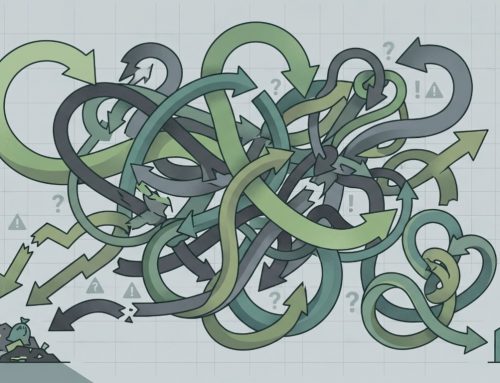
There’s a comfortable mental image of recycling: you put plastic in the yellow bin, it gets collected, it becomes new plastic. That image fits a small fraction of the reality. The harder truth — backed by Australia’s own waste data — is that most plastic in this country ends up in landfill. The question that matters then is: what happens to it once it’s there?
This article walks through what an Australian landfill actually is, how different types of plastic behave once they’re in one, why most “biodegradable” claims don’t survive landfill conditions, and where landfill-biodegradable plastic — a specific, technical category — fits in. The goal is to be clear about a topic that gets vague treatment in most consumer-facing content.
The Australian numbers, briefly
The Department of Climate Change, Energy, the Environment and Water (DCCEEW) publishes the National Waste Report every two years. The most recent edition reports on 2022–23 data and the picture is clear:
- Australia generated about 75.6 million tonnes of waste in 2022–23 — roughly 2.88 tonnes per person.
- Plastic waste alone accounted for about 2.99 million tonnes, or 114 kg per person.
- The national resource recovery rate is around 66% across all materials, and the recycling rate is 63%.
- But the recovery rate for plastic specifically is just 12% — the lowest of any major material category. Metals recover at 90%, building and demolition material at 84%.
That 12% figure is the one worth sitting with. It means roughly 88% of Australia’s plastic — close to 2.6 million tonnes a year — is not recovered. Most of it goes to landfill. So the practical question for any consumer or business plastic decision is: what does that plastic do once it’s underground?
What an Australian landfill actually is
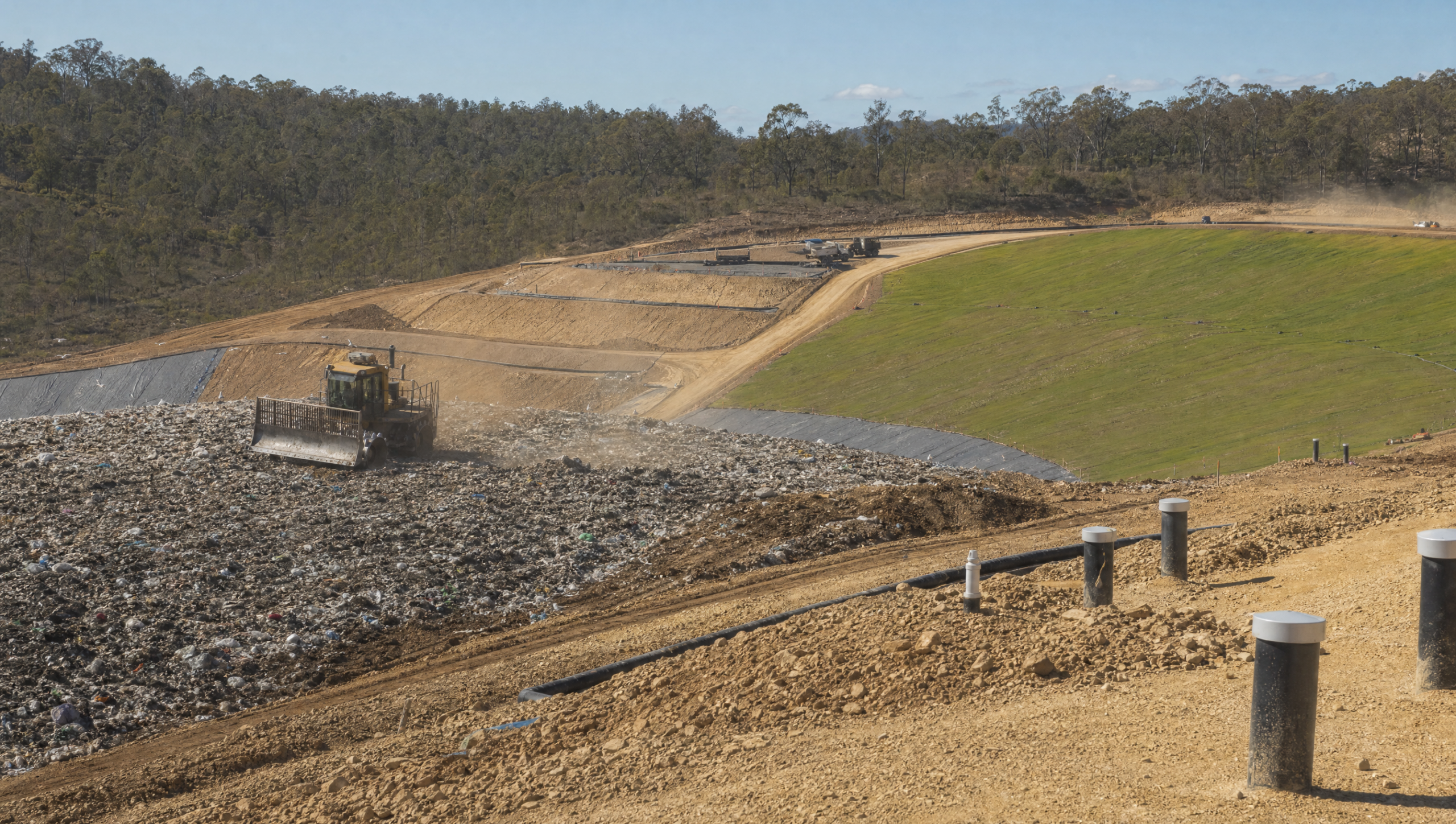
A modern Australian landfill is not a hole in the ground filled with rubbish. It’s an engineered structure built to specific design requirements — composite liners to prevent leachate escape, daily cover layers to reduce odour and pests, gas extraction systems, and (at the larger sites) capping systems to seal the landfill once it’s full.
Once waste is buried and the daily cover applied, conditions inside the landfill are anaerobic — oxygen-poor, microbe-rich, often warm from the metabolic activity of organic decomposition. Moisture is present but doesn’t flow freely. There’s also no sunlight.
Larger Australian landfills — those receiving roughly 75% of all municipal solid waste — actively capture the landfill gases (mostly methane) generated as organic matter decomposes. About 42% of all the landfill gas generated in Australia is captured, and most of that is used to generate electricity. This matters because methane is roughly 28 times more potent than carbon dioxide (CO₂) as a greenhouse gas, so capturing it and burning it for energy turns a climate problem into a comparatively much smaller one.
The 2025 Federal Landfill Gas Method under the Australian Carbon Credit Unit (ACCU) Scheme actively incentivises landfill operators to capture and destroy methane. The infrastructure exists. What’s less well understood is which materials produce methane in useful quantities and which just sit there inertly.
What breaks down in landfill, and what doesn’t
Things that do break down
Organic matter — food waste, garden waste, paper, cardboard, untreated timber — is what produces the most landfill gas. Anaerobic microbes consume the organic carbon, produce methane and CO₂ as byproducts, and gradually break the material down. This is the chemistry landfill gas capture systems are designed around.
The breakdown rates vary. Food scraps and garden waste degrade fastest — within a year or two. Paper and cardboard take longer, often five to ten years, because the cellulose is structurally tougher. Untreated wood can take decades. But all these eventually return their carbon to the system.
Things that don’t
Conventional plastic is the obvious one. The petroleum-based polymers in standard plastic — PET, HDPE, LDPE, PP — are not recognised as food by the microbes present in landfill. The plastic sits in the anaerobic environment essentially unchanged for hundreds of years, sometimes longer. There’s no biological process acting on it. Light degradation that might happen on the surface of a plastic exposed to sun and air doesn’t happen underground.
Glass and metal also don’t break down in landfill, though they’re both highly recyclable when sorted at the front end.
The category that doesn’t do what you’d expect
Industrial compostable plastic — the kind certified to AS 4736-2006 and marked with the seedling logo — is a particular failure case in landfill. These plastics are designed for the high-temperature (around 60°C), high-moisture, oxygen-managed conditions of a commercial composting facility. In the cool, anaerobic environment of a landfill, they don’t break down meaningfully. They’re not designed for landfill conditions and they don’t deliver their environmental benefit when they end up there.
This is a more common outcome than the marketing suggests. Australia has a limited network of commercial composting facilities, and almost no separate collection stream that gets industrial compostable packaging to them. So most industrial compostable plastic — by destination, if not by design — ends up in landfill, where it behaves much like conventional plastic for a very long time.
The terms that promise breakdown and don’t deliver it: degradable and oxo-degradable
Two terms appear on Australian packaging that sound like they belong in the breakdown category but don’t. Both are being phased out under Australia’s National Plastics Plan.
- Degradable plastic just means the material falls apart. It says nothing about biological breakdown. Many degradable plastics use chemical additives that cause the plastic to fragment over time — but the fragments are still plastic. They become microplastics rather than returning to the carbon cycle.
- Oxo-degradable plastic refers to a specific subset of degradable plastic. It contains metal-salt additives that accelerate fragmentation in the presence of oxygen and sunlight. Two problems: first, the fragments are persistent microplastics; and second, the reaction doesn’t even work in landfill, where there’s no sunlight and very little oxygen. Oxo-degradable plastic buried in landfill behaves much like regular conventional plastic — except for the metal-salt additive sitting in the soil with it.
The ACCC has been clear in its environmental claims guidance (finalised December 2023) that vague or unsubstantiated breakdown claims are a greenwashing risk. The 2025 National Plastics Plan targets phasing out problematic plastics, and oxo-degradable plastic is firmly in that category.
Landfill-biodegradable plastic: the category designed for landfill conditions
Landfill-biodegradable plastic is a different category to all of the above. The technology was developed commercially in the United States around 2010 and works on a specific mechanism — built-in landfill biodegradable technology that becomes activated in landfill conditions. An inert organic supplement is added to conventional plastic during the manufacturing process. The plastic looks, feels, and performs identically to standard plastic during use. The difference made by the organic supplement shows once the plastic reaches landfill.
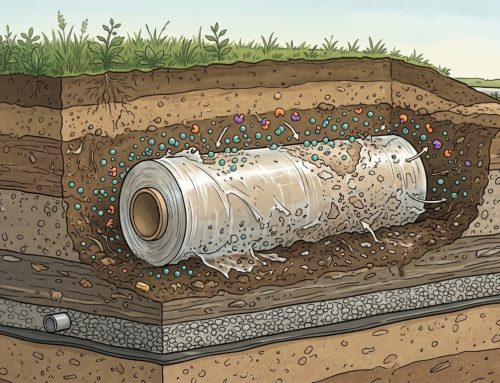
In the anaerobic, microbe-rich environment of a landfill, the organic supplement attracts the microbes that already exist in environment. The microbes recognise the organic supplement as food, begin to colonise the plastic surface, and start to secrete enzymes that break the carbon bonds in the plastic polymer. As the bonds break, the polymer depolymerises into shorter chains that the microbes can digest. Over time — measured in decades rather than centuries — the plastic is consumed.
Two things that are worth being precise about here:
- Breakdown produces biogas and humus, not microplastics. Because the microbes are digesting the polymer molecule itself rather than fragmenting it mechanically, the end products are methane, CO₂, and humus-like organic residue. Independent laboratory testing under ASTM D5511 (the international standard for anaerobic biodegradation testing) confirms this mechanism.
- The biogas can be captured. Because landfill-biodegradable plastic breaks down over decades — within the active management lifespan of a typical landfill — the methane produced is captured by the landfill’s gas collection system and used for energy generation. With conventional plastic, by contrast, any release of carbon happens long after the landfill has been capped and stopped being managed.
Landfill-biodegradable plastic isn’t a replacement for recycling. Where recycling actually works — rigid PET bottles, HDPE milk jugs, PP yoghurt tubs — recycling is the better outcome because the material gets reused rather than consumed. Landfill-biodegradable plastic exists for the categories where recycling realistically doesn’t happen: contaminated soft plastic, dog poop bags, mailing satchels, kitchen bin liners with food residue. For those categories, the destination is going to be landfill regardless. The question is what happens once it gets there.
At a glance: how each type of plastic behaves in landfill
| Plastic type | Behaviour in landfill | Timeframe | Microplastic risk |
|---|---|---|---|
| Conventional plastic | Does not biodegrade — sits inert | Hundreds of years, sometimes longer | Yes, through mechanical fragmentation over time |
| Degradable / oxo-degradable | Fragments mechanically; reaction limited without sunlight/oxygen | Fragmentation timeframe varies; microplastics persist for centuries | High — produces microplastics by design |
| Industrial compostable (AS 4736) | Does not break down — needs high-temperature commercial composting | Effectively unchanged in landfill | Low, but the plastic remains intact |
| Home compostable (AS 5810) | Partial breakdown in landfill, much slower than in compost | Years to decades — incomplete in many landfill conditions | Low |
| Landfill-biodegradable | Microbial breakdown of the polymer; produces biogas and humus | Years to decades — within the landfill’s active management period | No — the polymer is digested rather than fragmented |
Where landfill-biodegradable plastic makes the most difference
Not every plastic product needs to be landfill-biodegradable. A rigid water bottle that has a real recycling pathway is best served by being recyclable. The landfill-biodegradable category earns its place specifically in the segments where recycling isn’t going to happen — for structural reasons, not for lack of trying.
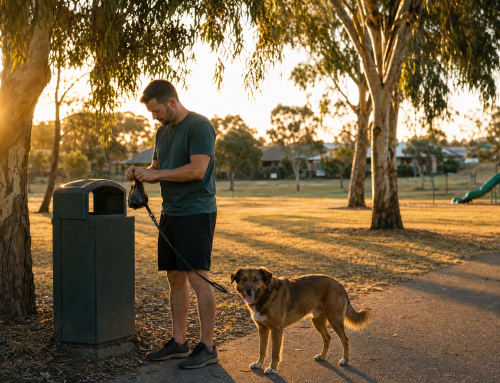
- Dog poop bags. Always contaminated with organic waste. Never recyclable. Always destined for general waste. The landfill-biodegradable choice changes what happens to the bag itself — measured in decades rather than centuries.
- Bin liners. Soft plastic, often wet, often contaminated with food. The realistic destination is landfill regardless of household intent.
- Mailing satchels and padded mailers. Soft plastic that has historically depended on supermarket soft-plastic drop-offs (REDcycle, now patchily replaced). Most go to general waste.
- Stretch wrap and pallet wrap. Warehouse and logistics use cases where the plastic is contaminated, mixed-material, or simply too large for any consumer-facing recycling stream.
- Cling wrap, gloves, disposable food packaging. Soft, food-contaminated, single-use plastic. Almost never recycled in practice.
All Biogone products fall into these categories. The strategic logic is to offer a better end-of-life outcome for the segment of plastic that recycling can’t, structurally, reach — not to compete with recycling where it actually works.
FAQs
About Biogone
Biogone is an Australian manufacturer of landfill-biodegradable plastic products — dog poop bags, bin liners, mailing satchels, cling wrap, gloves, and packaging supplies for businesses. All products are tested under ASTM D5511 for anaerobic biodegradation, carry standard resin codes for recycling compatibility, and are designed for the use cases where recycling isn’t structurally available — not as a replacement for recycling where it works.