Hi John, how did you get your start in the environmental industry?
I actually studied science — majored in geology and botany — and worked briefly in a few other areas before heading to the UK in 1998 on a working holiday visa. When I returned to Australia in 2000, I was job hunting and came across an ad for a sales role in the environmental industry. Because of my science background, especially in geology, I landed the job.
That role was with a company, which was run by Ross and Ramona. I had no idea at the time, but it turned out to be a pivotal moment — I ended up quickly progressing to National Sales Manager, as the company was growing fast. They needed someone in Melbourne because, one of the team members was moving to open their new Sydney office. From there, we just kept expanding — into Brisbane, Perth, New Zealand, Malaysia. It was really great!
Ross and I worked really well together during those years. Eventually, the company was sold. And I stayed on with the new owners for a while, but I’d always had that need to start something new. So when it felt like the right time, I got in touch with Ross and we started thinking about doing things differently — especially when it came to plastic waste in the industry.
We officially started FieldTech in 2012. But even before that, I had a brief stint as an environmental consultant. Less than a year — maybe six months. It was great experience, but I realised pretty quickly that wasn’t for me. Sales suited me better.
How did you and Ross come together to approach things differently?
So when I got back in touch with Ross, we started talking about how we could take a new approach—do things a bit differently in the environmental space. One big thing we noticed was that no one was really tackling the issue of plastic waste in our industry. We kept coming back to the question: Why isn’t anyone doing something about all this plastic waste?
In environmental consulting and drilling—especially groundwater sampling, soil sampling, and monitoring equipment—there’s a heavy reliance on single-use plastic consumables, and none of it is biodegradable. So even though our products were helping clean up contaminated sites, they were also contributing to the plastic pollution problem. Noticing the increasing use of disposable products and the rising prices, we set out on a mission to bring a new approach to the industry. One that would deliver and manufacture cost-effective products using recovered and recycled materials where practical.
What inspired the creation of Biogone as its own brand?
Well, we already had a product called ‘BioBailer’ for groundwater sampling — Ross had developed that with a contact in the US. It uses a special technology that makes the plastic landfill-biodegradable. We then started applying that same technology to the tubing and filters we were selling. We started small — adding the technology into our own products one by one and testing them out. But then we thought — what else can we do with this?
The first consumer product we tried was dog waste bags. Initially, we imported them from the US, but it was too expensive to keep doing that. We thought, “Why not make our own?” But dog bags didn’t really align with groundwater sampling gear, so we realised we needed a separate brand and website. That’s when Biogone really began to take shape.
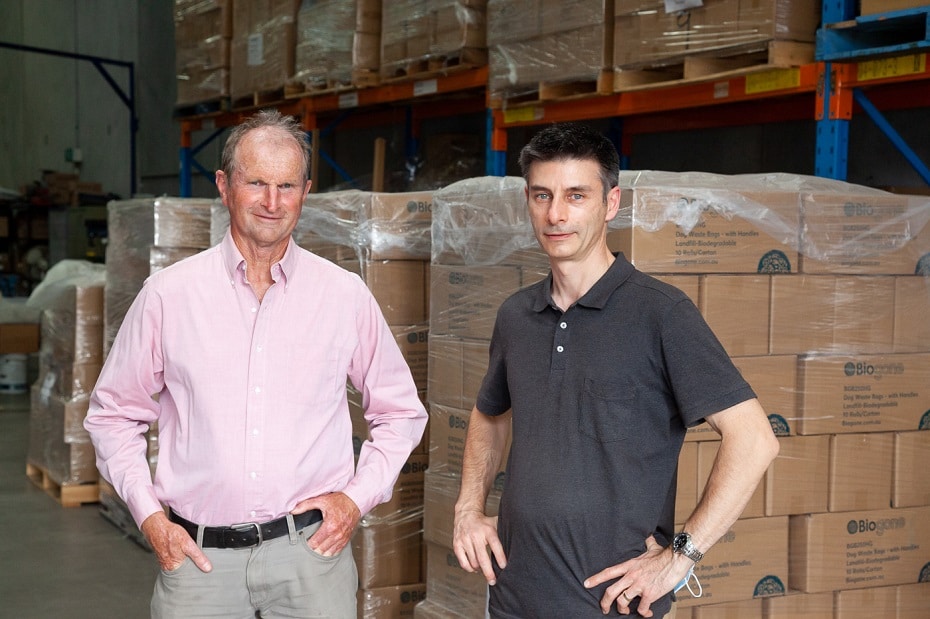
From there, it grew. We introduced garbage bags, stretch wrap — actually, stretch wrap was one of the first! We needed it ourselves for sending out pallets of goods. It just didn’t make sense to ship biodegradable products wrapped in non-biodegradable plastic.
So it was partly internal need, but also thinking about what your customers were experiencing?
Exactly. If someone receives an plastic-smart, landfill-biodegradable product wrapped in metres of standard conventional plastic film, it’s counter productive, and sends the wrong message. Sometimes you unwrap it and end up with waste plastic the size of a beach ball. We initially tried strapping things without film, but depending on what’s on the pallet, stretch wrap is often necessary. So we had the biodegradable stretch wrap made locally and started using it in-house. Then we thought — maybe other businesses want this too. We started asking around, and there was definitely an interest.
Customers would tell us things like, “The product’s great — what else can you do with this tech?” So we began thinking about everything we use in day-to-day operations: packing tape, the document envelopes you stick to boxes… and gradually we applied the same biodegradable technology to those as well.
Now there’s a whole packaging and shipping section on the Biogone website. It’s grown from simply solving our own logistical challenges into a full offering for other businesses.
You’ve taken it even further, by applying a few socially responsible, sustainable practices to your own operations too — like solar panels and recycling programs?
Yeah, it’s not just about selling landfill-biodegradable or recyclable plastic — it’s about being as eco-smart as we can across the board. We installed solar panels a few years back. It made sense — most of our energy use happens during the day, so we’re using what we generate. Although it’s a rental property, so the next tenant gets the benefit too — a bit like paying it forward.
Recycling is a big part of what we do too. We receive all sorts of packaging from suppliers — some use our biodegradable film, others don’t. Wherever possible, we recycle what we can. And we encourage our customers — especially consultants — to return used tubing. We’ve got a bin out the front for that. We work with a recycler who takes it all, as long as it’s sorted and packed into bulker bags. Once we fill up 10 of those one-cubic-metre bulker bags, they come and collect it and it gets recycled. It’s a system that works — and we’re proud of that.
What keeps you inspired in this space? What fuels your motivation?
Honestly, it’s just really rewarding to see our products out there being used — whether it’s FieldTech gear on a site, or Biogone bags in stores. Getting feedback from people — especially when they’re excited to be making a better choice for the environment — that’s what makes it worthwhile.
It’s great to feel like we’re part of a community that genuinely wants to do better. If we can help people make those small, better choices through products that are easy to switch to, that’s a win. It keeps us motivated to keep evolving and expanding what we offer.