Author: Dr. Ross Headifen (PhD)
Ross Headifen has a PhD in Mechanical Engineering and over 28 years of experience developing environmental and sustainable industry solutions. As co-founder of landfill biodegradable plastics brand Biogone and environmental equipment supplier FieldTech Solutions, Ross works closely with the food service sector—highlighting the importance of choosing plastics with a better end-of-life, particularly when most packaging ultimately ends up in landfill rather than being recycled. Biogone makes everyday plastic products with built-in landfill biodegradable technology.
Every dog owner in Australia goes through the same small ritual a couple of times a day: bag in hand, scoop, knot, into the bin. It’s such an automatic action that most of us never stop to think about what happens once that bag leaves our hand. The reality is more nuanced than the marketing on the packaging suggests — and for dog waste specifically, the choice of bag matters in ways that don’t apply to other plastic packaging.
This article walks through where dog poop bags actually go in Australia, why “compostable” dog poop bags can be misleading, what happens to the bag (and the poop) once it’s in landfill, and how to choose a bag that does what it claims to do. It’s written for dog owners who care, not for sustainability obsessives — practical, honest, and grounded in what Australian councils and waste systems actually do.
The scale of the problem (briefly)
Australia has somewhere over 6 million pet dogs. A medium-sized dog produces roughly 130 kg of waste per year. Even with conservative assumptions, Australian dogs collectively produce hundreds of thousands of tonnes of waste annually — almost all of which gets bagged and put in general waste.
Each one of those bags is a small piece of plastic that, if it’s conventional plastic, will outlast every dog alive today by a factor of ten or more. Conventional plastic dog poop bags persist in landfill for hundreds of years. The bag isn’t the biggest problem in landfill — food waste and methane from organics are — but it’s the most easily fixable part of the picture, because the alternatives perform identically during use.
Where the bag actually goes after you bin it
In Australia, virtually all dog poop bags end up in landfill. Not recycling, not compost. Landfill. There are three reasons for this, and understanding each is the foundation for choosing a bag that actually matches reality.
Reason 1: Dog poop bags can’t be recycled
Plastic recycling streams require clean material. A plastic bag full of organic waste contaminates whatever stream it touches — that’s why even soft-plastic recycling programs (where they still exist) won’t accept bags with contents. The contamination concern isn’t squeamishness; it’s about preventing organic matter from disrupting the mechanical and chemical processes downstream.
Reason 2: Most councils don’t accept dog poop in green/FOGO bins
If you’ve ever wondered whether you can put a bagged dog poop in the green bin, the short answer is almost certainly no. The reason isn’t arbitrary: most Australian councils contract commercial composting facilities that supply the resulting compost to farmers growing food crops. Farmers won’t accept compost contaminated with pet waste — there are real pathogen concerns with dog and cat faeces (parasites, bacteria) that can survive composting unless conditions are very tightly controlled.
A small number of councils run separate pet-waste schemes or accept pet waste in specific FOGO contracts, but they’re the exception. Check your local council’s actual rules — most websites have a search function for “pet waste” or “dog poop.” Assume general waste unless you’ve confirmed otherwise.
Reason 3: Home composting dog waste needs a dedicated system
You can compost dog waste at home, but not in your normal vegetable compost. Pet waste needs a separate, dedicated pet-waste compost system — typically a deep underground composter or a worm-farm setup specifically rated for pet waste — because of the same pathogen concerns that prevent kerbside composting.
If you have a pet-waste compost set up at home, that’s a great option — and home compostable dog poop bags fit naturally with it. But for most Australian dog owners without that infrastructure, the realistic destination is landfill. And once you accept that, the question of what the bag does in landfill becomes the relevant question.
What happens to the bag (and the poop) in landfill
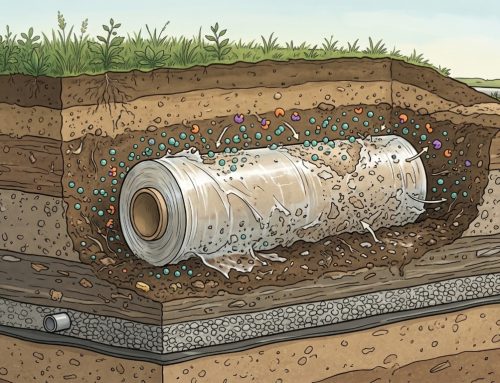
Modern Australian landfills are engineered anaerobic environments — oxygen-poor, microbe-rich, capped to control odours and capture gas. The dog poop and the bag enter that environment together and behave very differently.
The dog poop
Organic matter, which is what dog waste is, is exactly the kind of material that breaks down in landfill — within a year or two, by anaerobic microbial digestion. The breakdown produces methane (CH₄) and carbon dioxide (CO₂). At larger Australian landfills, those gases are captured by landfill gas systems and used to generate electricity. So the poop itself isn’t a long-term landfill problem.
Conventional plastic bag
Standard plastic dog poop bags — the cheap ones, the supermarket ones, most generic eco-marketed ones — are conventional polyethylene plastic. The microbes in landfill don’t recognise the polymer as food. The bag sits there largely unchanged for centuries, eventually fragmenting into microplastics over geological timescales. The poop is long gone; the bag persists.
Landfill-biodegradable bag
Landfill-biodegradable bags are made from the same base plastic as conventional bags (so they perform identically during use — same strength, same leak-resistance, same shelf life) but include a built-in landfill biodegradable technology — an organic supplement that microbes recognise as food. Once the bag enters landfill, the organic supplement attracts microbes, the microbes begin to digest the polymer molecule, and the plastic breaks down over years to decades. The breakdown produces biogas and humus-like organic residue — the same kinds of outputs as the poop itself.
Crucially, this happens within the active management lifespan of the landfill, which means the methane produced can be captured rather than leaked. With conventional plastic, by contrast, any carbon released happens long after the landfill has been capped and stopped being managed.
“Compostable” bag in landfill: the misleading case
This is the bit most marketing skips. Industrial compostable dog poop bags (certified AS 4736) are designed to break down in high-temperature commercial composting facilities at around 60°C. In the cool, anaerobic environment of a landfill, they don’t break down meaningfully. They’re not designed for landfill conditions, and they don’t deliver their certified benefit when they end up there.
Home compostable bags (certified AS 5810) are designed for backyard compost conditions and do partially break down in landfill, but more slowly and incompletely than in the conditions they’re built for. They’re the right choice if you have a pet-waste home compost; they’re a sub-optimal choice if the bag is heading to landfill, because they have a 12–18 month shelf life that landfill-biodegradable bags don’t have.
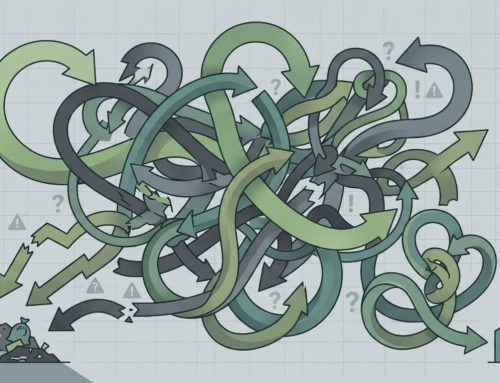
This is why the language matters. A bag marketed as “compostable” or “biodegradable” without specifying where it actually breaks down can be misleading in this specific use case, because the dog-poop-bag use case almost always ends in landfill, and most compostable bags don’t work there.
How each bag type performs for dog waste
| Bag type | In use | If composted at home | If goes to landfill |
|---|---|---|---|
| Conventional plastic | Strong, cheap, long shelf life | Doesn’t break down | Persists 100+ years |
| Landfill-biodegradable | Same as conventional plastic | Doesn’t fit composting use case | Years to decades, biogas captured |
| Home compostable (AS 5810) | Good but degrades in storage (12–18 mo) | Breaks down in pet-waste compost | Partial breakdown, slow |
| Industrial compostable (AS 4736) | Good but degrades in storage | Won’t break down (needs commercial facility) | Doesn’t break down meaningfully |
| Degradable / oxo-degradable | Same as plastic in use | Fragments — not composts | Fragments into microplastics |
The right choice depends on a single question: what will actually happen to the bag when you put it in a bin? For most Australian dog owners, that’s landfill — and landfill-biodegradable is the option built for that destination.
What to look for in a dog poop bag
Once you’ve decided which category fits your disposal pathway, the practical features come down to four things. Skip any of them and the rest doesn’t matter much.
- Strength. The bag has one job. If it tears mid-walk or splits when you tie it, every other feature is irrelevant. Look for a thickness of at least 15 microns and a brand that specifies puncture resistance.
- Leak-proof seam. The base seam is the failure point on cheap bags. A heat-sealed leak-proof base is the difference between confident handling and walking the rest of the way home with rising concern.
- Easy tear-off, easy open. Rolls should perforate cleanly so you’re not wrestling with a tear in cold or wet weather. The bag opening should separate easily — some cheap bags stick together at the rim and need two-hand fumbling.
- Dispenser-compatible. Standard mini-rolls (typically about 5 cm diameter) fit most lead-mounted and post-mounted dispensers. Custom-sized bags from some brands don’t fit standard dispensers — read product specs before ordering.
Strength and leak resistance are the two that earn the purchase. Eco messaging is what closes the sale once you trust the bag will do its primary job.
Bag dispensers and the small upgrades that make daily use easier
Most dog owners use whatever rolls they happen to have, stuffed into a pocket. A few small upgrades make daily use noticeably easier:
- Lead-mounted dispenser. Clips onto the dog’s lead or your wrist strap, holds a mini-roll of bags. Means you never leave home without bags, and you never need to fumble in a pocket. The single most useful daily upgrade for active dog owners.
- Post-mounted dispenser. For homes with a back gate or a frequently-used walking entry, a post-mounted dispenser holds rolls and gives you a refill point on the way out. Works well in shared housing where multiple people walk the same dog.
- Bag-of-bags discipline. Whatever dispenser you choose, build the habit of refilling it the moment it runs low. The frustration of being caught without bags mid-walk is the single biggest reason people resent the daily ritual.
Biogone’s dog bag dispensers are built specifically for mini-roll formats and integrate with Biogone’s landfill-biodegradable and home compostable bag ranges. If you’re upgrading from a generic system, getting the dispenser and bags from the same supplier removes the compatibility worry.
Three things to avoid
- Bags labelled “degradable” or “oxo-degradable.” These fragment into microplastics rather than biodegrading. Australia’s 2025 National Plastics Plan is phasing them out. They’re not a sustainable choice and arguably make the problem worse than conventional plastic by spreading microplastic fragments more widely.
- Compostable bags going to general waste. If the bag is going to landfill (the realistic destination for most Australian dog owners), choose landfill-biodegradable. Compostable bags don’t deliver their certified benefit outside the conditions they’re designed for, and they have a shorter shelf life.
- Putting bagged poop in the kerbside recycling bin. Surprisingly common, despite being clearly wrong. A bagged dog poop in recycling contaminates the entire load. It’s general waste — always.
FAQs
About Biogone
Biogone is an Australian manufacturer of landfill-biodegradable and certified home compostable dog poop bags. Our bags are trusted by over 40 Australian councils and tens of thousands of Australian dog owners. All bags are leak-proof, dispenser-compatible, and tested for anaerobic biodegradation under ASTM D5511. We make the bag that does the daily job your dog needs, with a better end-of-life outcome for the bag itself.